
















Over the concerns of some councillors about the rushed process and the potential risk to taxpayers, Peterborough city council has endorsed a motion to reduce development charges in the city by 50 per cent in the hopes of getting a share of $8.8 billion in federal and provincial funding over the next 10 years intended to increase housing by making it more affordable.
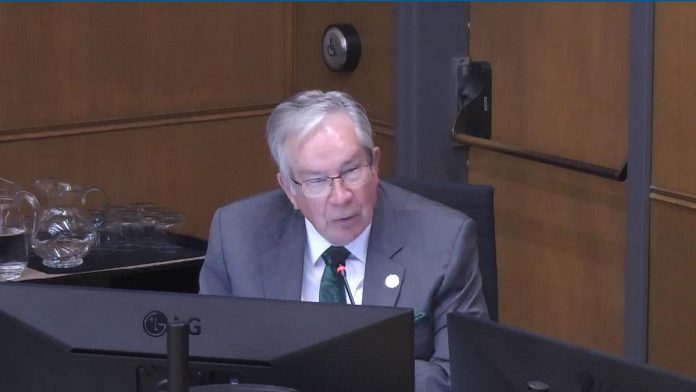
At the end of council’s general committee meeting on Monday night (June 8), Mayor Jeff Leal introduced a lengthy motion under “other business” that proposed the reduction in development charges, which the city levies against new development as a primary source of funding for growth-related capital expenditures, as part of the city’s application to the Ontario government’s new Development Charge Reduction Program (DCRP).
After reading out the 466-word motion, the mayor said the city has has “conversations over the last number of weeks with both the province of Ontario and the government of Canada” and that the motion would be a “bold step” in meeting the city’s housing commitments.
“We need to do everything to pursue the goal that we have for the province of Ontario to build 4,700 new units by the year 2031,” Leal said. “Tonight with this motion to make the deadlines of the government of Ontario, it will allow us to pursue this target in a great and significant way by reducing development charges over the next period of time.”
New provincial program rewards municipalities with funding for reducing development charges
Back in March, Premier Doug Ford and Prime Minister Mark Carney signed the Canada-Ontario Partnership to Build, which includes $8.8 billion in federal and provincial funding over 10 years for Ontario municipalities that reduce and maintain low development charges, as well as a harmonized sales tax (HST) rebate, with the intent of reducing the cost of new homes.
On June 1, the Ontario government opened applications for the DCRP, with a June 19 deadline to coincide with the HST rebate. Municipalities that reduce development charges for all residential types by 30 to 50 per cent or greater, and maintain the reductions for at least three years, would qualify for funding under the program. Municipalities would be expected to contribute a minimum of 10 per cent of project costs.
The province will assess municipal applications based on the percentage of the development charge reduction, the percentage of the municipality’s financial contribution, and the number of homes projected to be built as a result of the reduced development charges.
“Housing-enabling projects would be prioritized with consideration for the number of homes enabled by the project,” states a provincial media release. “Municipalities are strongly encouraged to be as ambitious as possible in their (development charge) rate reductions to secure as much funding as possible for their communities.”
Of the 444 municipalities in Ontario, those that currently levy development charges — over 200 urban municipalities — would be eligible to apply to DCRP.
The City of Peterborough’s development charges for residential units currently range from $42,555 to $68,604 per unit, depending on the type of unit, plus area-specific charges. In 2025, the city earned $6.5 million in revenue from development charges.
Councillors question process behind last-minute motion
With respect to the mayor’s motion, after councillors Dave Haacke and Kevin Duguay spoke in support of it, councillor Alex Bierk asked councillor Andrew Beamer, as chair of general committee, whether the mayor’s motion was a reconsideration of a council decision.
Bierk said council had earlier approved development charge rates and was now being asked to reduce them, also noting that council’s new procedure by-law prohibits motions to reconsider a council decision from being introduced under other business.
Beamer ruled that the motion was not a reconsideration, but told Bierk that it would need to have a two-thirds majority vote as an item under other business, as it would if it were a reconsideration.
“I don’t know if I feel comfortable even voting on this,” Bierk said in response. “When we’ve when we’ve discussed the idea of raising or lowering development charges, we’ve looked at the comparator data of other municipalities. Those have been lengthy conversations that we’ve had at this council that have been substantiated through a lot of data by consultants that we paid to do the work to provide us that data.”
“This council has made decisions on 18-storey buildings and the selling point against the negative impact for those decisions in the arguments around the table has been ‘Look at the development charges we’re going to get. Look at how much revenue the city is going to receive in development charges by approving these projects.’ I’m unclear in reading this motion on the fly which projects would be benefited through this cut rate, which wouldn’t, which we’ve already received development charges for … and all these questions just lead me as a councillor to want to have more time to consider this.”
“I’m wondering why — if as the mayor stated that there’s been long conversations with the province and the government of Canada about this government program that was forthcoming — why it wasn’t put in a report from staff so that we could consider this, so that the public could could consider this, in the way that we always do? … I’m all for taking bold steps, I just don’t want to step into a hundred foot hole.”
Councillor Joy Lachica echoed Bierk’s concerns, pointing out that council had passed the development charges by-law that is in effect from January 1 to December 31 of this year and that previous motions to modify an approved by-law have been ruled as motions to reconsider. She said the mayor’s motion should have come forward as an agenda item and that councillors should have had the opportunity to review it in advance.
She asked finance and corporate commissioner Richard Freymond whether proceeding with the motion was a “wise move,” and Freymond said that this was the first opportunity to bring it forward to council given that staff — despite the earlier senior-level conversations between the city and the provincial and federal governments — only received the DCRP guidelines on June 1.
Freymond added that, given the province’s June 19 deadline, “I will not have another opportunity to bring it back.” He said staff have not yet confirmed specific projects that would benefit from the DCRP.
Councillor Lesley Parnell said she didn’t consider the motion to be a reconsideration because it was a new government program. She spoke in support of the motion, asking “Can we afford not to do it?” and adding “We have to take the step” due to the lack of shovel-ready projects. She said the DCRP will be a “fantastic kickstart for affordability, for anybody who wants to buy a house.”
She said that, although the province should have given municipalities a lot more time to consider it and conduct analysis, “This is an opportunity that we cannot pass up.”
Taxpayers could be on the hook if city’s funding application is unsuccessful
In his comments, councillor Keith Riel noted there are 400 municipalities in Ontario and the province’s largest municipalities including Toronto would probably “eat up” most of the $8.8 billion for the program. He asked staff what would happen to those municipalities that don’t receive funding.
In responding to the question, Freymond explained the DCRP is not available to all 444 municipalities in Ontario, but is “tailored to the urban municipalities.”
“The councillor is quite correct, though, to be concerned — there is risk,” Freymond added. “There is no guarantee that if council reduces the rates tonight by 50 per cent. that we will ultimately get rewarded through infrastructure funding. That is not guaranteed, so there is a risk here. But there will be definitely, in my opinion as I said a moment ago, a cost if we do not do this.”
Riel asked Freymond if city taxpayers would be on the hook for lost development charge revenues if the city’s application to DCRP is not successful.
Freymond said that, if the city’s application is successful, he expects the city would receive more revenue through infrastructure funding than it would lose from development charges. However, he confirmed that if the city’s application is unsuccessful, growth-related infrastructure not covered by development charges “would be funded by the taxpayer.”
Freymond’s comment reflects a statement in his April 13 report to general committee on the 2025 annual report for the city’s development charge reserve funds, which noted that the city’s capital commitments exceed the $30.3 million balance in the reserves by a factor of five.
“Given the challenging economic climate for developers, staff have contemplated the reduction of development charges in the city’s growth areas to stimulate residential development,” the report reads. “Given the city has already incurred the outlay of cash required to build the infrastructure to enable the growth to occur and done so under the premise that the monies would be collected from the development community at a future time, reducing the development charges requires the taxpayer to fund the reserve shortfalls.”
Riel asked why there couldn’t have been a special general committee meeting to consider the motion, especially given the potential risk to the taxypayer. Freymond said councillors will have an opportunity to finalize their decision on the motion at council’s regular meeting next Monday (June 15).
In speaking in support of his motion, Mayor Leal said there have been telephone conversations “over the past couple of weeks” with the provincial and federal goverments “to make sure that the City of Peterborough was well-positioned to take advantage of this program.”
“There’s about 250 to 275 urban municipalities in Ontario that are in competition for the $8.8 billion,” the mayor said. “It’s crucial for our infrastructure planning that we take this opportunity to acquire what is our fair share of this $8.8 billion.”
“While we haven’t identified projects yet, I’ll give you a project just off the top of my head that I think would be a candidate for this. This would be the Cold Springs secondary planned area that we’ve identified as our Alto train site,” Leal said. “We do know that (Ontario’s Minister of Municipal Affairs and Housing Rob Flack) will be arriving in Peterborough on July the 9th, and I want to make sure that, prior to his visit, we put the City of Peterborough in the best possible light for infrastructure funding from the province of Ontario.”
Motion passes after council rejects deferral for a special meeting
Councillor Lachica made a motion to defer the Mayor’s motion until council could hold a special general committee meeting prior to the regular council meeting on June 15 so that councillors could get some answers, especially given the risk to taxpayers that Freymond mentioned.
“I feel like when we have news of something, even if it’s imminent and it’s just happened, please share it with council so that we can absorb and reflect, and so that we all have the information at the same time,” Lachica said. “I find it really frustrating when there is a lack of transparency about new information. We need a few days to absorb this.”
Speaking in support of Lachica’s motion, councillor Bierk point out the provincial government will make shovel-ready projects a priority and that the municipality would need to contribute at least 10 per cent of project costs. After Freymond said that that a minimum municipal contribution is standard for cost-shared projects, Bierk replied that the funding would be prioritized for municipalities that can contribute more than 10 per cent.
Councillor Gary Baldwin suggested that, rather than having a separate meeting, councillors could send questions to Freymond while city staff are working through the issues, and Freymond could send a memo to councillors in advance of the June 15 council meeting to address the questions.
After some further debate, councillors voted 3-7 against Lachica motion to defer, with her and councillors Bierk and Riel voting in favour and Mayor Leal and councillors Don Vassiliadis, Beamer, Haacke, Parnell, Duguay, and Baldwin voting against. Councillor Matt Crowley was absent from the meeting.
Councillors then voted on the Mayor’s motion, which passed carried 8-2 with councillors Lachica and Bierk voting against it.
Items endorsed by general committee will be considered by council for final approval next Monday (June 15), when registered delegations will be heard.
Council meetings are streamed live at www.peterborough.ca.